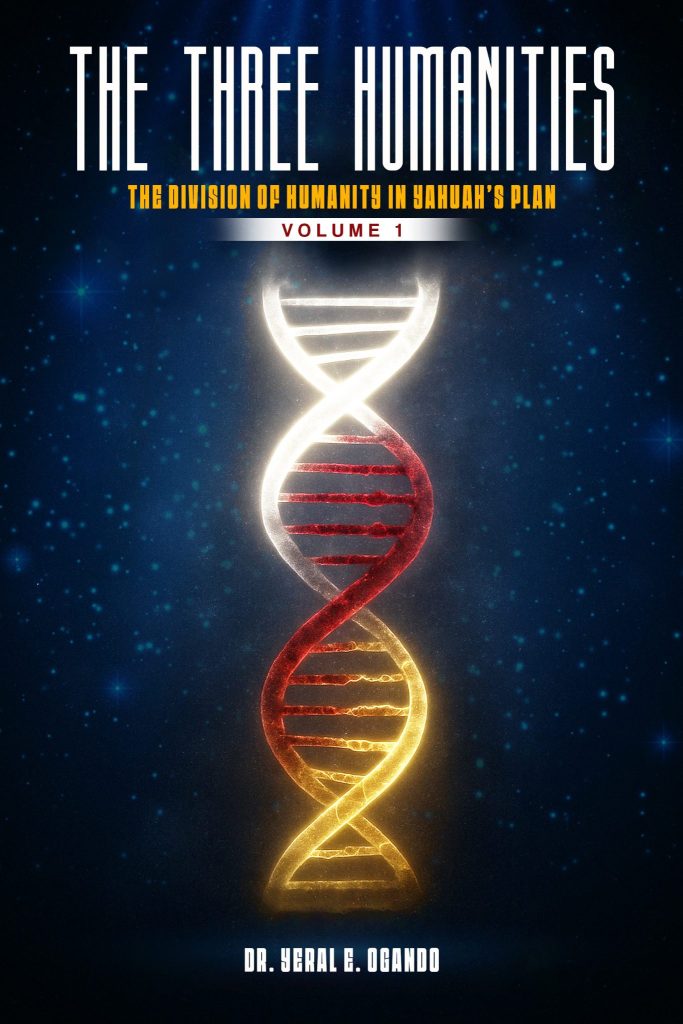
The Three Humanities
The Three Humanities™ – Book 3, Chapter 7: Scripture Follows the Pure Line, Not the Hybrid One
This chapter explains why Scripture follows the pure line rather than the hybrid one, revealing a narrative principle established by Yahuah Himself.
 Login required to download
  Buy Paperback on Amazon
 Please login to track progress.
← Back to The Three Humanities™: The Corruption of the Second Humanity – The Narrative Principle Originated by Yahuah
7.1 — The Foundational Key to Interpreting the Bible
One of the greatest keys for understanding Scripture is this unshakeable truth: the Bible is not the record of all humanity. It is the record of the redeemed humanity. It follows the lineage through which the plan of salvation flows — the line chosen, protected, purified, and guided to bring forth the Mashiyach. This narrative structure is not the invention of rabbis, theologians, or historians. It is a storytelling principle that originates with Yahuah Himself.
Like every great story, there is a protagonist, a central heroic arc, a redemptive journey, characters essential to victory, and one lineage that carries the destiny forward. The Scriptures follow this pattern intentionally. Yahuah reveals only what is relevant to the covenant line, not everything that existed. This principle becomes unmistakable when we examine three clear examples.
7.2 — Example 1: Adam’s Children and the Selective Genealogy – Scripture Highlights Seth, Not Every Child
Many assume Adam and Chawwâh had only three sons — Qayin, Hebel, and Sheth — because only these three are emphasized. But this is not a limitation of history; it is a limitation of what is necessary for the covenant storyline.
Scripture hints at a much larger population. Where did Qayin’s wife come from? Where did Sheth’s wife come from? How could cities form so early? Jubilees fills in the historical details. Adam and Chawwâh had many sons and daughters (Jub. 4:10). Qayin married his sister Âwân (Jub. 4:9). Sheth married his sister Azûrâ (Jub. 4:11). Adam and Chawwâh had nine additional sons beyond the three named (Jub. 4:10). Thus, Scripture focuses on Seth’s line because it is the line of redemption — the line leading to Mashiach. The rest existed but had no part in the covenant story.
7.3 — Example 2: Miryam and Yoseph’s Children and the Messianic Focus — Scripture Focuses on Yahusha, Not Every Sibling
The Renewed Covenant writings follow the same divine principle. The Gospels do not list all of Miryam and Yoseph’s children — not because they didn’t exist, but because they are not central to the Messianic mission.
Yet Scripture clearly confirms Yahusha had siblings. “His brethren: Yaăqôb, Yôsêph, Shimôn, Yahûdâh” (Matt. 13:55). “His sisters, are they not all with us?” (Matt. 13:56). His mother and brothers sought Him (Luke 8:19). Sha’ul mentions “Yaăqôb, the brother of Âdônây” (Gal. 1:19). His brothers are listed among the disciples (Acts 1:14). The Bible is consistent: it highlights only what is essential to the divine mission. The emphasis is not on the household of Miryam but on the calling of Yahusha.
7.4 — Example 3: Peter’s Wife and the Selective Apostolic Focus — Peter Had a Wife — Scripture Simply Didn’t Name Her
Kêph had a wife because Yahusha healed Peter’s mother-in-law (Matt. 8:14–15), and Sha’ul affirms Peter traveled with his wife (1 Cor. 9:5). Why is she never named? Not because she didn’t exist, but because her name contributes nothing to the covenant storyline. Again: what Scripture does not name is not nonexistent — it is simply not necessary for redemption.
7.5 — The Scriptures Follow ONE Line: The Line of Redemption
This is the genealogical river Scripture follows: Sheth, Enosh, Kenan, Mahalalel, Yared, Enoch, Methuselah, Lamech, Noach, Shem, Eber, Abraham, Yitschaq, Ya’aqov, Yahudah, Dawid, Yahusha ha’Mashiach. This is one unbroken river — the river of redemption. Scripture follows the river, not the mud around it. All other lines, though real, are irrelevant to the covenant purpose.
7.6 — Why Scripture Does Not Follow the Hybrid Lines
The descendants of the Nephilim, the Repha’im, the Emim, the Anakim, the Zamzummim, the Zuzim, and all hybrid tribes existed, thrived, and influenced history. But they did not bear the Ruach, did not carry Adam’s breath, did not have the capacity for redemption, were not part of the covenant, and were not part of the promise.
They existed parallel to the covenant line but not inside it. Thus the Bible mentions them only when they collide with redemption, such as giants in the land of Kana’an, Og of Bashan, Anakim in Hebron, Emim in Moab, Zamzummim in Ammon, and Golyath of Gath. They are the antagonists, not the protagonists. The Bible is not anthropology. It is a covenant document.
7.7 — Scripture’s Focus Reveals Yahuah’s Heart
Yahuah highlights Enoch who walked with Elohiym, Noach who was perfect in his generations, Abraham the friend of Elohiym, Yitschaq the child of promise, Ya’aqob the chosen vessel, Yahudah the royal line, Dawid the man after Yahuah’s heart, and Yahusha the Redeemer of creation.
He does not focus on Nimrod’s kingdom, the Anakim empires, the Emim in Moab, the Repha’im strongholds, or Philistine hybrid dynasties. This is because Yahuah reveals what advances salvation, not everything that happened in world history.
7.8 — Yahuah Is the Original Author of Protagonist-Focused Storytelling
Every human story — film, epic, novel, or myth — follows the divine blueprint: a chosen line, a heroic lineage, a mission of redemption, a conflict with darkness, a final victory. Human storytelling imitates the pattern Yahuah designed. Scripture is the original narrative structure. Yahuah selects the characters, directs the storyline, removes irrelevant branches, preserves the protagonist, and brings the Redeemer through the chosen line. All other stories echo the one Yahuah wrote.
7.9 — FINAL TRUTH
The Bible is the story of redemption, not the story of every bloodline. It follows the line of salvation, the carriers of covenant, the heirs of promise, and the pure seed that leads to Yahusha. The hybrids existed, but they were never the focus because they were never the carriers of redemption. Yahuah’s Word follows the one lineage through whom He would bring forth Yahusha ha’Mashiach, the Light of the World, the Seed of the Woman, the One who crushes the nachash’s head. This is why Scripture follows the pure line — because the pure line carries the plan of salvation for all creation.
Please register or login to track your reading progress.
👉 Register / Login
Comments