Yahuah: Restoration Guide
Different types of calendars
Chapter 8 of YAHUAH: Restoration Guide explains lunar, solar, and Hebrew calendars, the Gregorian reform, and the biblical start of the day at dawn.
 Login required to download
  Buy Paperback on Amazon
 Please login to track progress.
← Back to Yahuah: Restoration Guide
Moon, Moon–Sun, Sun, Hebrew & Gregorian Calendars — and the Biblical Start of the Day (Dawn)

Different types of calendars
Let’s look at some important facts about the different types of calendars that have been the guide or compass used by mankind to determine certain times, solemn dates and holidays. Some calendars were based on what was observed in the stars, the sky, and the position of the planets, the moon and the sun. This is where the different types of calendars come from:
Moon: The rotation of the moon is used as a basis for measuring the months of the year.
Moon-sun: Created by the Sumerians or Babylonians, Mesopotamia and the Middle East. As they had to take into account the weather for crops and agriculture, they also had to observe the seasons.
Sun: Created by the Mitsrayimians, who understood that a year lasted 365 days and divided the months into 30 days (12 x 30 = 360 days). Since the count was not enough to reach the 365 days, they used the remaining 5 days for holidays or solemn days[1]. They looked directly at the sun as the main star, Amun-Ra[2] as the sun god and supreme deity of Mitsrayim. His calendar was based on the movement of the sun.[3]
Here are some important notes about calendars that we should consider before talking about the biblical calendar.
Chinese Calendar[4]
Each year is made up of 12 months and, every three years, an extra month is added to level the gap. The date on which the new Year is celebrated is always different, since it moves to the day on which the first full moon occurs, that is, between our January 21 and February 21.
Chinese New Year is celebrated on the second New Moon, after the winter solstice and following a legend where Buddha and 12 animals, which correspond to the Chinese zodiac signs, they are the protagonists. The animals are as follows: the rat, the ox, the tiger, the rabbit, the dragon, the snake, the horse, the goat, the monkey, the rooster, the dog and the pig.
Islamic Calendar
Islam also has its own calendar, and the year is slightly shorter than ours – 364 days, divided into 12 months. This calendar is based on the lunar movement; each month begins the day after a new moon night.
The Islamic lunar year has between 354 and 355 days which are divided into months of 29 or 30 days. The days take their name from their numerical order: Sunday is the first day and Saturday is the seventh and last. The exception is on Friday, which takes its name from the midday prayer, when the entire Islamic community tries to gather.
Hindu Calendar
This is governed by both solar and lunar principles, which gives way to 12 months that are guided by the moon and have between 29 and 30 days each. In addition, every three years, an extra month is added.
The Indian year is divided into 6 seasons, one season every two months: Vesanta (spring), Grichma (summer), Varea (rains), Sarad (autumn), Hemanta (winter), Sis (dew).
In India, New Year’s Day is celebrated around April 15, when it is commemorated when, according to them and in their superstition, Bramha created the Universe. This means that the Hindu year begins in spring.
The Hebrew Calendar
This calendar consists of 12 months, although there are leap years that last 13 months and occur every 3 years.
The Hebrew calendar combines between the solar year and the lunar month. For this reason, the days begin at the beginning of the night, which is why the beginning of the months is marked by the new moon and the harvest cycles.
The Yahudiy’s New Year coincides with the beginning of the economic year in Southwest Asia and Northeast Africa, marking the beginning of the agricultural cycle.
The names of the Hebrew months have their origin in ancient Babylon, where they were adopted by the Yahudiy exiled by King Nebuchadnezzar II, an exile that lasted 70 years (586 BC). C. – 516 a. C). In the past, the months were named only by their numerical order, starting in the spring with the first month, Âbı̂yb (Nisan). But in the times of the New Testament there was a second calendar of civil or official use that began with the month of Tisri, whose first day was the civil New Year or Rosh Hashanah, which continues in force to this day. It should be noted that the Hebrew calendar is not the biblical calendar.
This is the calendar with the names of the months in Hebrew and the month, or months that corresponds in the Gregorian calendar, that is, the calendar used in the world today. You will see that every Biblical or Hebrew month falls in two months of the Gregorian calendar; this is because the Biblical month falls in most cases in the middle of the month in the Gregorian calendar, thus always occupying two months.
| Mention of the month in the Bible. | Name of the Month | According to the Gregorian calendar | Months of the Holidays |
| Šhemōṯh 12:2-37; 13:4; Nehemiah 2:1 | Âbı̂yb | March – April | Passover Unleavened bread |
| 1 Kings 6:1 | Iyar or Zif | April – May | |
| …. | Siwan | May – June | Shâbûa – Pentecost |
| Yechezqêl 8:14 | Tammuz | June – July | |
| … | Ab | July – August | |
| Nehemiah 6:15 | Elul | August – September | Feast of the Trumpets Day of Atonement |
| 1 Kings 8:2 | Ethanim or Tishri | September – October | Feast of Tabernacles |
| 1 Kings 6:38 | Marcheswan o Bul | October – November | Feast of the Eighth Day – The Great Saturday |
| Zechariah 7:1 | Kislew | November –December | |
| … | Tewet | December – January | |
| Zechariah 1:7 | Shewat | January – February | |
| … | Adar | February –March |
Julian Calendar[5]
The Julian calendar was the one used before the Gregorian one. Established in honor of Julius Caesar, it came into operation in 45 BC. He had a year divided into 12 months and, like the Gregorian, he had a leap day in February and every four years.
Anyway, with this one, one day was lost every 129 years, because it did not coincide so much with the solar year. With the Gregorian Reform, this error was corrected and now only one day is lost every 3,000 years.
Roman Calendar
Originally the Roman calendar had 10 months (6 months of 30 days and 4 of 31 days). The beginning of the year was Martius[6] (mars or March), named in commemoration of the god of war.
1. Martius: month of Mars (March), god of war, father of Romulus and Remus[7]
2. Aprilis: month of opening of flowers.
3. Maius[8]: month of Maia (May), goddess of abundance
4. Junius[9]: month of Juno, godess of home and family
5. Quintilis: fifth month
6. Sextilis: sixth month
7. September: seventh month
8. October: eighth month
9. November: ninth month
10. December: tenth month
11. Januarius[10]: month of Janus, god of the portals
12. Februarius[11]: month of the purification bonfires (February)
It should be noted that the fifth month or Quintilis became Iulius (Julius or July) in commemoration of Julius Caesar[12].
The month Sextilis or sixth became Augustus or August in commemoration of Octavian Augustus[13]
Origin of the Sol Invictus on December 25
The purpose of all these changes was to be able to achieve unification and comply with Constantine’s willingness to take the date of the god Mithras, whom he worshipped, or the sun god as a solemn date to be celebrated for centuries to come and idol Tammuz mentioned in the book of Yechezqêl (Ezekiel) and Yirmeyâhû (Jeremiah)
The winter solstice began to be celebrated since prehistoric times in what is now Europe and Asia Minor. And that is why, in many cultures, long before Christianity, the day 25 (of December) was associated with the birthday of the Sun, with feasts to different deities that inspired various religions. The god Mithras, in Rome, was one of these, also the Sol Invictus, because the cycle of the new year was Christmas or Natalis solis invicti (the Birth of the Undefeated Sun).[14]
As the feast Dies Natalis Solis Invicti was becoming part of the oldest Roman festivals, that is, the Saturnalia, were growing in importance. These festivals were held in honor of Saturn, the god of sowing, and began on December 17 and ended on the 25th of the same month. These were days of joy, exchange of gifts, great banquets, games and the liberation of slaves.
This was how the name of this pagan celebration was changed to the name we know today as Christmas or the supposed birth of the god of Constantine or of the empire. Observing that feast was a mandate, so not celebrating or keeping this pagan feast led, at that time, to persecution and death.
What we have not been told that there is an ancient idol or pagan god behind this celebration, one mentioned in the bible, which is Tammuz. Search for yourself and discover the blatant truth behind this idol, you will be surprised.
The days of the Weeks and their dedication
At the same time (321) and based on the Mesopotamian calendar, the Emperor Constantine also implemented the seven-day week. In addition, he decreed that on Sunday (dies solis, day of the sun) it was a day of rest to worship the new god. Thus, the Biblical day of rest (Saturday) was fraudulently changed by these people to the one we know today as Sunday or the day of the sun.
Sunday: dies solis or the day of the sun (worship of the sun).
Monday: dies lunae or the day of the moon (worship of the moon).
Tuesday: Martis díes or Mars day (god of war).
Wednesday: Mercurii díes o day of Mercury (god of commerce)
Thursday: dies Iovis o day of Jupiter (god of Roman mythology, which is equal to Zeus, Greek god)
Friday: Veneris dies or day of Venus (goddess of Roman mythology).
Saturday: The English term “Saturday” comes from the biblical Latin sabbătum, then from the Greek σάββατον (sabbaton), and this one from the Hebrew יום השבת (shabbath), which means “rest” or “Shabbath day”. The only day to which they could not change the name nor YAHUAH allowed them to desecrate it by changing the name was the Shabbath. This day retains its original name and means rest or Sabbath. In the beginning the days of the week were enumerated as they had no name. The original names are still preserved in the Portuguese language, with the exception that they include the name of Sunday. But it was-“first day, second, third, fourth, fifth sixth and Saturday or Shabbat”.
The Gregorian Calendar[15]
The Gregorian Calendar is a revision of the Julian Calendar or a more up-to-date version. It was implemented based on the declarations of the Council of Nicaea and is called Gregorian from the year 1582 and by the name of Pope Gregory XIII.
The Gregorian reform was born from the need to put into practice one of the agreements of the Council of Trent: to adjust the calendar to eliminate the gap produced since the first Council of Nicaea that was celebrated in 325. The astral moment at which Easter (Saturnalia, Sun Invictus, Tammuz…) was to be celebrated and, in connection with it, the other movable religious holidays had been fixed.
In short, what mattered was the regularity of the liturgical calendar, for which it was necessary to introduce certain corrections in the civil calendar. Basically, it was about adapting the civil calendar to the tropical year. This is the calendar that was accepted worldwide and used in most of the world.
So far we have seen different types of calendars and how they are all governed until we reach the Gregorian calendar, the one used in most countries. We must remember that the Gregorian calendar is the calendar created by Pope Gregory XIII, in other words, it is the Roman and Catholic calendar or coming from the reform of Constantine; the sun and the moon are observed to create the times and epochs.
However, in the Middle Ages and after the fall of Rome, Christianity firmly prevailed. January 1st was considered too pagan date, that’s why many countries where Christianity dominated wanted the new year to be marked on March 25th.
Finally, Pope Gregory XIII introduced the Gregorian calendar and January 1st was reinstated as the New Year in Catholic countries. In England, however, who had rebelled against the authority of the Pope and professed the Protestant religion, it continued to be celebrated on March 25 until the year 1752.
Biblical Calendar
Finally we can share some points about the biblical calendar which is found and governed under the scriptural norms given by YAHUAH to his people. Many around the world use this calendar because it is the one established in the Bible and not one that follows the dispositions of men or institutions that only seek their own benefit.
To conclude, we talked earlier about the different types of existing calendars and how through the ages people have been governed by the moon, the sun, the constellations, the seasons and nature in general to define the times and epochs, and the days. In the end, everything is based on what people understand as the beginning of the day.
Start of the Day
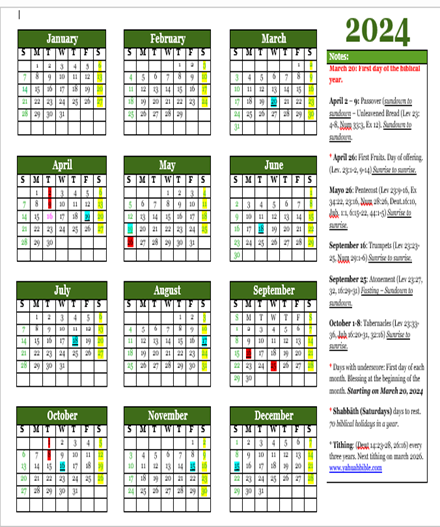
First of all, many people say that the day starts from midnight, that’s why today 12:01 is already part of the next day. However, that theory is wrong and false.
Others say that the day starts in the afternoon, after 6pm, and that’s why they start counting the day from this moment until 6pm the next day. This is also a wrong theory.
On the other hand, there are those who say that the beginning of the day is with the first sunlight and they start the day from the first rays of the sun until the second before the first rays of the sun of the next morning or the next day. This theory is also wrong, however, it is the closest to the truth.
All these errors and misinterpretations are a consequence of the different translations of the Bible into other languages. We do not understand the Hebrew term used and then we come to wrong conclusions about the topic or about the beginning of the day. However, the answer is simpler than we think and has always been there. In fact, our ancestors, who could neither read nor write, did know the answer to what humanity is confused about today.
I remember perfectly that my grandmother and grandfather got up very early in the morning to work and the idea was before “dawn breaks”. It’s amazing, they didn’t know about letters or studies, but they weren’t confused in their thoughts. They knew that the day began with the “Dawn”, not with the moon nor the sun. They knew that before the sun rose there was a clarity called “Dawn” and this was the one that marked the beginning of the day. “From Latin albus, the alba[16] it refers to the sunrise or to the first appearance light of the day in the sky before the Sunshine.”
Before Dawn there is a moment of darkness, which represents the end of the previous day; there then appears the Dawn that marks the beginning of the new day and then the sun appears. That’s how nature works. It is enough to observe and realize to understand what the beginning of a new day indicates to us. We call this the Biblical day according to the creation of YAHUAH ELOHIYM.
Berēšhīṯh 1:3-5 3 And ĔLÔHÎYM said, Let there be light: and there was light. 4 And ĔLÔHÎYM saw the light, that it was good: and ĔLÔHÎYM divided the light from the darkness. 5 And ĔLÔHÎYM called the light Day, and the darkness he called Night. And the evening and the morning were the first day.
Be light and was light: the term used in Hebrew for the word light is Ôr (אוֹר), and it means “illumination, including the rays, happiness, clarity, day, light, morning and sun”. This tells us that the lights were created at that moment and that that light marks the beginning of the new day, not necessarily the sun.
Berēšhīṯh 32: 24 And Yaăqôb was left alone; and there wrestled a man with him until the breaking of the day.
Berēšhīṯh 32: 26 And he said, Let me go, for the day breaks. And he said, I will not let you go, except you bless me.
In verses 24 and 26 he tells us “until the breaking of the day”, however, in Hebrew , it uses the term Elâh (עָלָה) which means to ascend, to rise up and the second term used for the word day is Shachar (שַׁחַר) which means dawn or dawn: – early day, morning light. Where does it come from?
What we are literally seeing in these verses is the beginning of the day or the first light of day, or the beginning of the day, which is synonymous with the breaking of day. Then it is perfectly understandable and visible that the day begins at dawn or at first light in the morning.
Remember that in Berēšhīṯh 1 everything on the first day of creation began with the light. Do not forget that there was no sunrise until the fourth day of creation.
This is why many of us observe and start our days at the break of dawn, with the first light of dawn, that is, according to the Bible.
This makes the biblical calendar fall on different dates than the Gregorian calendar, since all the months in the Bible have 30 days (12 x 30 = 360). Most of the 7 most important Biblical holidays fall on different dates on the Gregorian calendar. For example, the first month of the year according to the Bible and according to the words of YAHUAH it is March – April of the Gregorian calendar. That is, the month of Âbı̂yb. Šhemōṯh 12:2 This month will be the beginning of the months for you; this will be the first one for you in the months of the year.
In the Book of Jubilees we read the following verses in order to understand how the world is.
Jubilees 6: 36 For there will surely be those who will make observations of the moon, how (she) disturbs the seasons and arrives from year to year ten days earlier. 37 therefore there will come upon them years when they will disturb (the order), and they will make (day) abominable on the day of testimony, and dirty day of the holiday, and they shall confound the holy one with the unclean one every day, and the unclean day with the holy one; for they shall err concerning the months and Shabbath and feasts and Jubilees. 38 therefore I command you, and bear witness unto you, that you may bear witness unto them; for after your death your sons (shall) trouble them, so that they shall not make the year three hundred and sixty-four days only (364), and for this reason they will be mistaken about the new months and seasons and Shabbath and festivals, and they will eat all kinds of blood with all kinds of flesh.
In these verses we can see some important points that we should pay attention to.
Observations of the Moon: those who rule cults and give worship to the moon as a deity.
Dirty day of the holiday: those who have corrupted the feasts of YAHUAH for pagan holidays and they have changed the date (days and months) making then that the world celebrates its pagan holidays.
They will confuse the days, the holy one with the unclean one… they will be mistaken about the months, Saturdays, feasts and jubilation: the same thing we are seeing today, people no longer make a distinction between the holy day and the unclean day. All days are the same for the world, Saturday is no longer the Shabbath for them because they have changed it; also, they have even abolished holidays and there are no jubilees anymore.
These verses tell about our time and how the world is today. Let’s reflect, think, scrutinize, retain the good and act before it’s too late.
Please register or login to track your reading progress.
👉 Register / Login
Comments