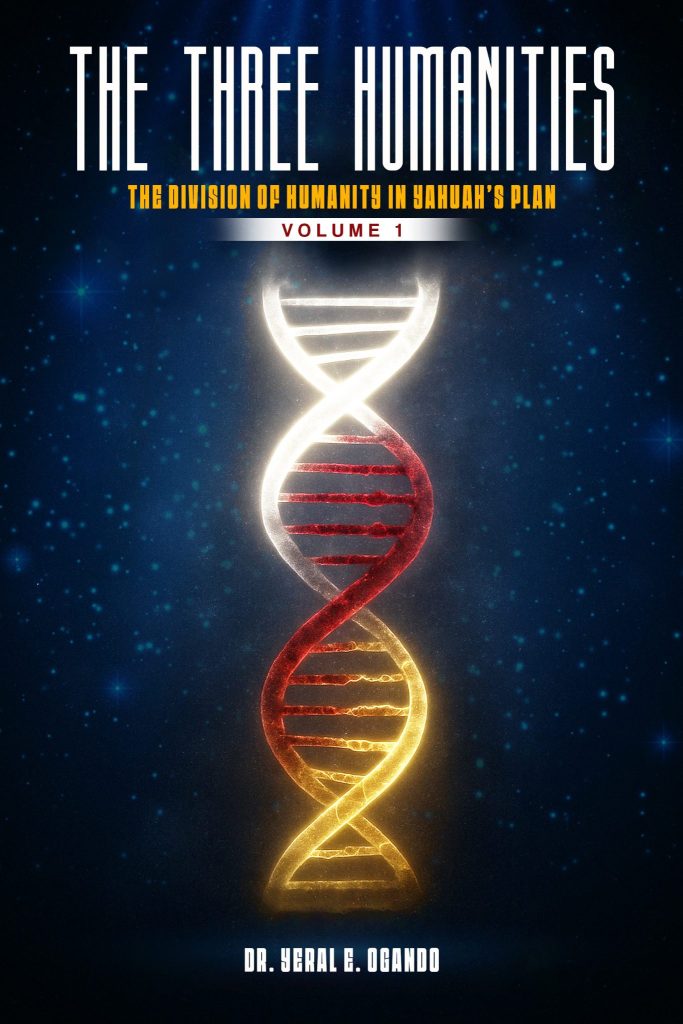
The Three Humanities
The Three Humanities™ – Book 2, Chapter 5: “Like One of Us”
This chapter explains the meaning of “Like one of us,” clarifying that it refers to knowledge rather than corruption within Yahuah’s design.
 Login required to download
  Buy Paperback on Amazon
 Please login to track progress.
Knowledge, Not Corruption
How Awareness Changed Humanity — and How Yahuah’s Redemption Was Already in Motion
Bereshith 3:22 is one of the most misinterpreted verses in Scripture. It has been used for centuries to teach ideas the Scriptures never claim: that Adam became wicked, that Adam became corrupt, that Adam lost the image of Elohiym, or that Adam inherited a sinful nature. But the text itself, when read through the restored Scriptures and the lens of Jubilees, teaches something profoundly different — something that reveals the early stages of Yahuah’s redemption plan.
5.1 Adam Became Like Yahuah in KNOWLEDGE — Not in Corruption
“And Yahuah Elohiym said, Behold, Adam has become as one of Us, to know good and evil…” (Bereshith 3:22).
This verse clarifies one essential truth: Adam became like Yahuah in knowing, not like the Nachash in rebelling. Yahuah Himself defines what changed: knowledge, awareness, and understanding. He does not say that Adam became corrupt, became wicked, became sinful, or lost His image. The change was epistemological, not moral. It was knowledge, not nature; awareness, not corruption; understanding, not defilement.
And because Yahuah Himself knows good and evil — and remains perfectly holy — it is impossible to say that knowing good and evil makes a being evil. To claim that would mean that if knowing good and evil makes one evil, then Yahuah must also be evil — an impossible blasphemy. Thus, Adam did not become corrupt; Adam became aware.
5.2 What Changed Was His CONDITION — Not His CREATED NATURE
Awareness awakened instantly, but corruption did not. After the disobedience, their eyes were opened, their awareness increased, their innocence ended, their mortality began, their environment changed, and their access to the Tree of Life was cut off. But their tzelem Elohiym — their divine image — remained completely intact.
Adam did not lose his spiritual identity, become sinful in nature, become morally decayed, become demonized, or become spiritually corrupt. None of this is recorded in Genesis, Jubilees, or any inspired text. Genesis and Jubilees portray Adam after the fall offering sacrifices, teaching his sons, walking with Yahuah, living in righteousness, and retaining the image of Elohiym. Adam sinned — but Adam did not become a creature of darkness. He remained the head of the First Humanity until his death.
5.3 Disobedience Brought CONSEQUENCES — Not Corruption
Yahuah’s words were specific, and the results were precise: mortality, not wickedness; exile, not spiritual contamination; toil, not moral decay; awareness, not corruption; distance from Eden, not distance from Yahuah’s presence. Adam’s nature was not replaced; his environment was. Adam’s essence was not destroyed; his access to immortality was. Adam did not lose the image; he lost the garden where that image was expressed in glory.
The origin of disobedience is not the origin of corruption. Adam and Chawwâh did not eat wickedness, did not receive corruption, and did not become spiritually twisted. They simply broke a command and experienced the consequences.
5.4 The Redemptive Plan: Yahuah Stepped In IMMEDIATELY
The purpose of this book is to unveil Yahuah’s redemption plan at every stage. And what we see in Chapter 5 is extraordinary. The moment Adam disobeyed, the plan of redemption activated — not centuries later, not with Noach, not with Abraham, not with Mosheh, and not only with Yahusha. Immediately.
5.5 Redemption Through PROTECTION
When Yahuah removed Adam from Eden, it was not punishment — it was protection. If Adam had eaten from the Tree of Life in a disobedient state, rebellion would have become eternal, corruption would have become immortal, salvation would have become impossible, and humanity would be trapped in disobedience forever. Therefore, Yahuah blocked the Tree not to banish man but to preserve man. Mortality is mercy. Exile is kindness. Boundaries are redemptive protection.
5.6 Redemption Through PROMISE
Right in the middle of judgment, Yahuah speaks the first prophecy: “The seed of the woman will crush the head of the Nachash” (Bereshith 3:15). Before Adam dies, before corruption appears, before the Watchers fall, before the Flood, before the covenant, before the Torah — Yahuah announces Yahusha. Redemption begins before history even continues.
5.7 Redemption Through CONTINUED FELLOWSHIP
After the fall, Yahuah speaks to Adam, hears Adam, teaches Adam, receives Adam’s sacrifices, covers their nakedness, still blesses the family, and still guides the generations. Disobedience strained the environment — not the relationship. Yahuah did not abandon them — He drew closer.
5.8 Redemption Through LIMITING CORRUPTION
Yahuah set a boundary: no immortality in disobedience, no access to the Tree of Life, no eternal rebellion. These boundaries create the future space for the Flood, the covenant, the Torah, the prophets, Yahusha’s incarnation, Yahusha’s atonement, the resurrection, the Kingdom, and the New Creation. The entire plan begins here — with Yahuah preventing eternal corruption so He can one day restore eternal righteousness.
“Like One of Us”: The Redemption Within Awareness
Adam became like Yahuah in knowledge, not like the Nachash in rebellion. Awareness awakened — corruption did not. Disobedience brought mortality, separation from Eden, boundaries, and awareness. But it also triggered the first movement of redemption: protection from eternal corruption, promise of the Messiah, preservation of the image of Elohiym, continued fellowship, limitation of rebellion, and the beginning of the redemptive blueprint.
Adam did not lose the image of Yahuah. He lost only the garden where that image shone perfectly. The plan of redemption was born in Eden — and it continues through every chapter of humanity’s story.
Please register or login to track your reading progress.
👉 Register / Login
Comments